

How To Draw A Supply And Demand Curve
10 MIN READ
What Are Supply and Demand Curves?
Understanding How Quantity Effects Market Price

© GettyImages
AleksanderNakic
The laws of supply and demand determine what products y'all can buy, and at what cost.
Imagine the scenario: you arrive at the market to stock up on fruit, but it's been a bad year for apples, and supplies are depression. The price has gone up, even since last week – simply yous accept the increase and snap them up anyhow.
On the plus side, at that place'south been a bumper ingather of pears. The growers are bang-up to sell equally many as they can before their produce starts to rot, and they've slashed their prices accordingly. But you're in no hurry – you lot know that if you lot come up back at the end of the day they'll be even cheaper.
For nigh of usa, as consumers, these basic laws of supply and demand are and then familiar, they're almost 2d nature: plentiful goods are inexpensive; scarce appurtenances cost more than. Merely in business, these concepts are used in a more nuanced style to examine how much of a production consumers might purchase at different prices, and the quantity yous should offer to the marketplace to maximize your acquirement.
In this article, we'll explore the human relationship betwixt supply and demand, and how you lot tin use this knowledge to make meliorate pricing and supply decisions.
The Law of Demand
Need refers to how much of a product consumers are willing to purchase, at different cost points, during a sure fourth dimension catamenia.
We all take limited resources, and we take to decide what we're willing and able to purchase. As an example, permit's expect at a simple model of the demand for gasoline.
Note:
The gasoline prices example, used throughout this commodity, is for illustration only. It is not a description of the real gasoline market.
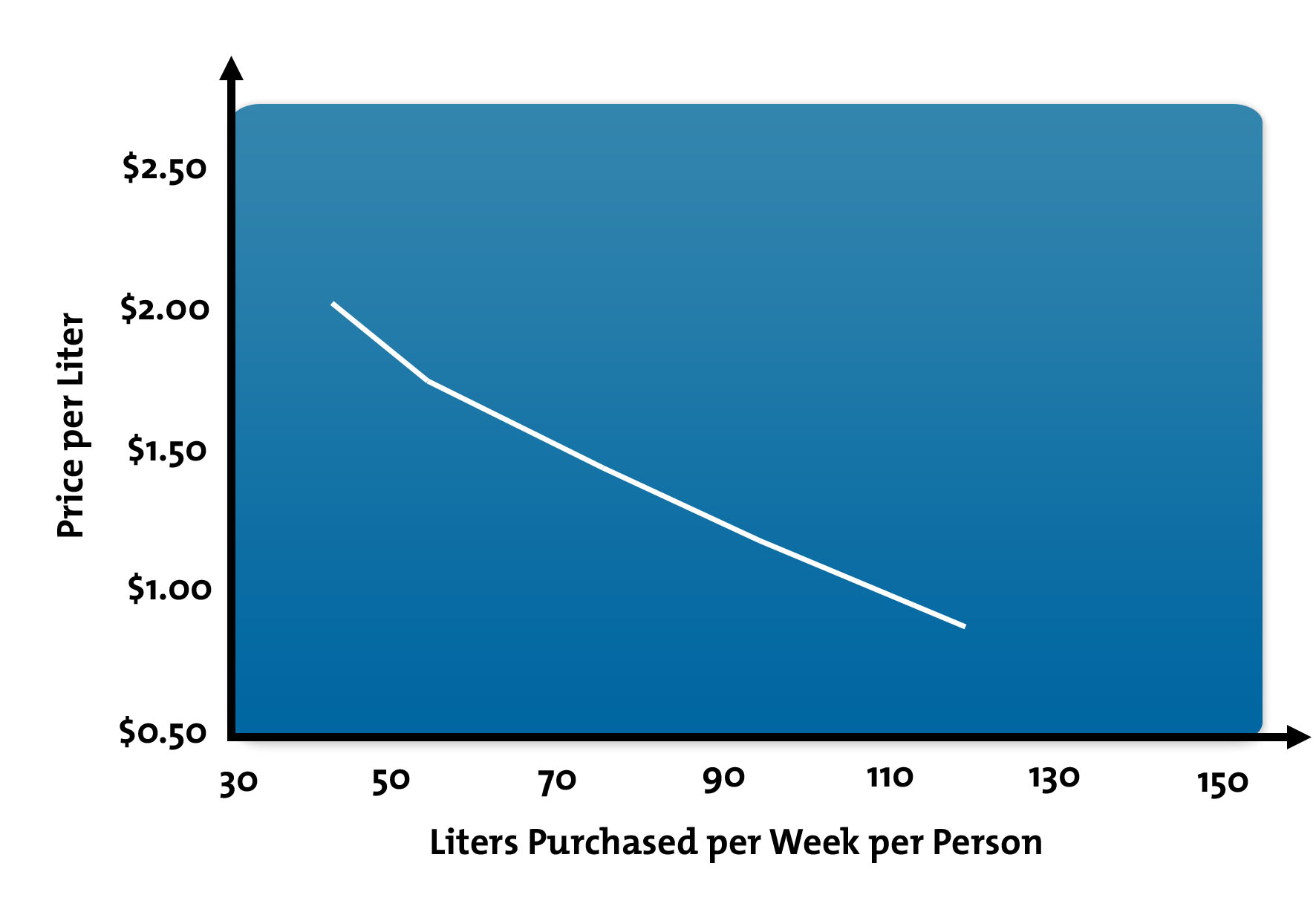
If the price of gas is $2.00 per liter, people may be willing and able to buy l liters per week, on average. If the cost drops to $1.75 per liter, they may purchase 60 liters per calendar week. At $1.fifty per liter, they may buy 75 liters.
You can limited this data in a table, or "schedule," similar this:
| Heir-apparent Demand per Consumer | |
|---|---|
| Price per liter | Quantity (liters) demanded per calendar week |
| $two.00 | l |
| $1.75 | sixty |
| $1.50 | 75 |
| $i.25 | 95 |
| $1.00 | 120 |
As the toll of gas falls, the demand increases – people may cull to make more nonessential journeys in their leisure time, for example, or just top upward their tanks if they conceptualize an imminent price increase. Simply price is an obstacle to purchasing, so if the price rises once more, less volition be demanded.
In other words, at that place is an "changed" human relationship between toll and quantity demanded. This means that when you lot plot the schedule above on a graph, you go a downwards-sloping demand curve, as shown in Figure 1:
Figure 1: Need Curve for Gasoline
The Law of Supply
While need explains the consumer side of purchasing decisions, supply relates to the seller's want to make a turn a profit. A supply schedule shows the amount of product that a supplier is willing and able to offer to the market, at specific toll points, during a certain time catamenia.
Note:
Supply variations occur because product costs tend to vary by supplier. When the price is low, only producers with low costs can brand a profit, so simply they produce. When the price is high, fifty-fifty producers with high costs can make a profit, and then everyone produces.
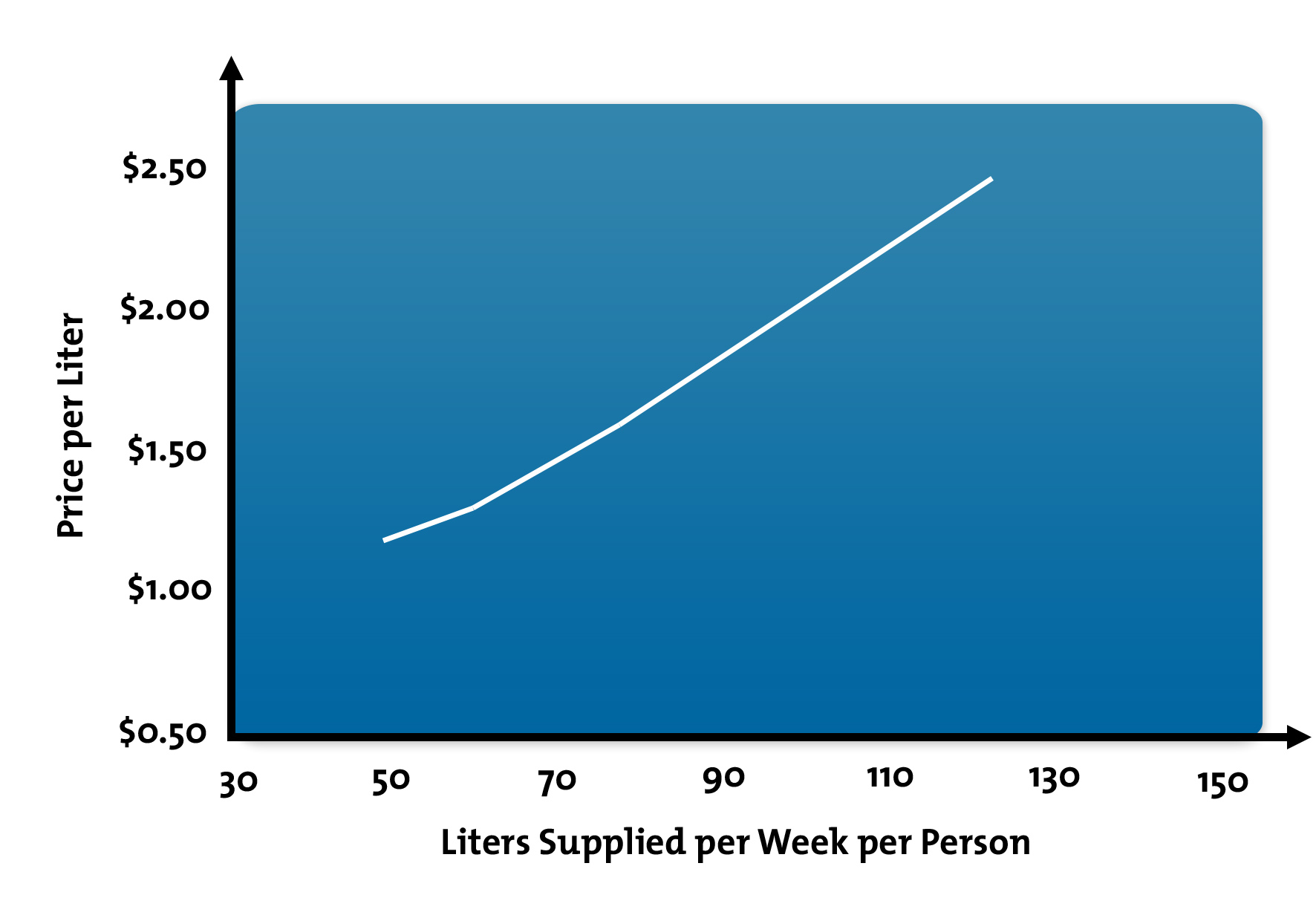
In our case, the schedule beneath shows that gas suppliers are willing to provide fifty liters per consumer per week at the low price of $1.20 per liter. But, if consumers will pay $2.15 per liter, suppliers will provide 120 liters per week. (Remember, we've assumed a uncomplicated economy in which gas companies sell directly to consumers.)
| Gas Supply per Consumer | |
|---|---|
| Price per liter | Quantity (liters) supplied per week |
| $i.20 | l |
| $one.30 | 60 |
| $one.l | 75 |
| $1.75 | 95 |
| $2.15 | 120 |
Equally the toll rises, the quantity supplied rises, likewise. As the price falls, so does supply. This is a "direct" human relationship, and the supply curve has an upward slope, as shown in Effigy 2.
Figure 2: Supply Curve for Gasoline
Using Supply and Demand to Set Price and Quantity
So, if suppliers want to sell at high prices, and consumers want to buy at low prices, how do yous set the cost you lot charge for your production or service? And how do you know how much of it to brand bachelor?
Let's go back to our gas example. If oil companies try to sell their gas at $2.fifteen per liter, would it sell well? Probably not. If they lower the price to $1.20 per liter, they'll sell more as consumers volition exist happy. But will they make enough turn a profit? And volition in that location be enough supply to run across the higher need past consumers? No, and no again.
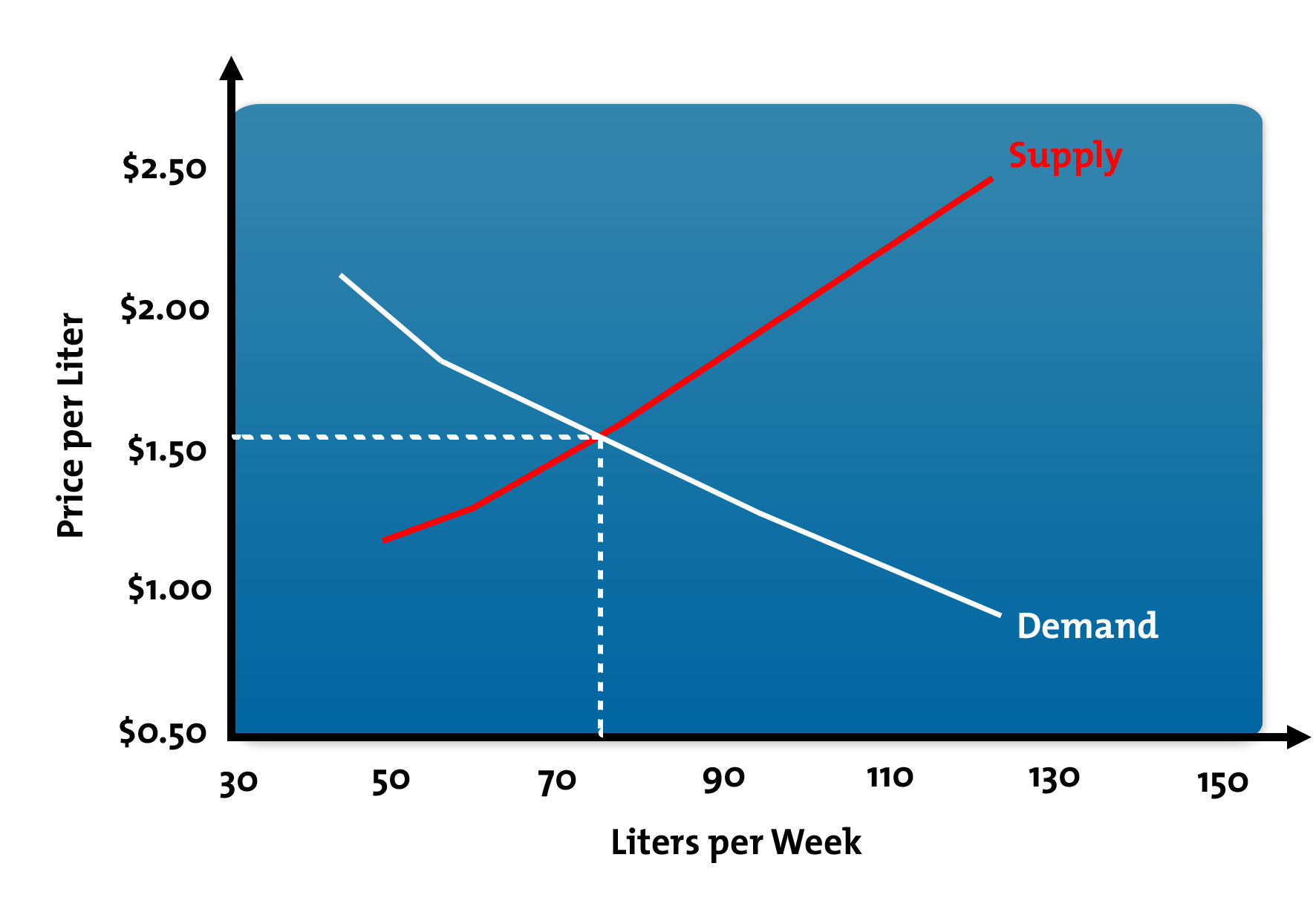
To determine the cost and quantity of goods in the market, we need to discover the price bespeak where consumer demand equals the amount that suppliers are willing to supply. This is called the market "equilibrium." The cardinal idea of a gratis marketplace is that prices and quantities tend to motility naturally toward equilibrium, and this keeps the market stable.
Marketplace Equilibrium: Where Supply Meets Demand
Equilibrium is the indicate where need for a product equals the quantity supplied. This means that there's no surplus and no shortage of goods.
A shortage occurs when demand exceeds supply – in other words, when the price is besides low. However, shortages tend to bulldoze upward the price, because consumers compete to purchase the product. As a outcome, businesses may hold dorsum supply to stimulate demand. This enables them to raise the price.
A surplus occurs when the price is too high, and need decreases, even though the supply is bachelor. Consumers may start to use less of the production, or purchase substitute products that are more affordable. To eliminate the surplus, suppliers reduce their prices and consumers commencement buying over again.
In our gas case, the market equilibrium toll is $1.l, with a supply of 75 liters per consumer per week. This is represented past the point at which the supply and need curves intersect, as shown in Effigy iii.
Figure 3: Marketplace Equilibrium
Price Elasticity
When you consider what price to prepare for your product or service, it's important to remember that not all products bear in the same manner. The extent to which the demand for your product is afflicted by the price you fix is known as "cost elasticity of need."
Inelastic products tend to be those that people always want to purchase, simply generally only in a fixed quantity. Electricity is an example of an inelastic product: if power companies lower the price of electricity, consumers probably won't apply a lot more power in their homes, considering they don't need more than they already employ. But, if electricity prices rise, need is unlikely to fall significantly, because people still need power.
Withal, need for inessential or luxury goods, such as restaurant meals, is highly rubberband – consumers chop-chop choose to end going to restaurants if prices go up.
So, if demand for the products or services that your company offers is elastic, you may desire to consider methods other than raising prices to increase your acquirement – such every bit economies of scale or improving production efficiency, for example.

Get the Free Newsletter
Learn essential career skills every week, plus get a bonus Essential Strategy Checklist, gratuitous!
Read our Privacy Policy
Changes in Demand and Supply
Equally nosotros've seen, a modify in price usually leads to a change in the quantity demanded or supplied. But what happens when there's a long-term alter in price?
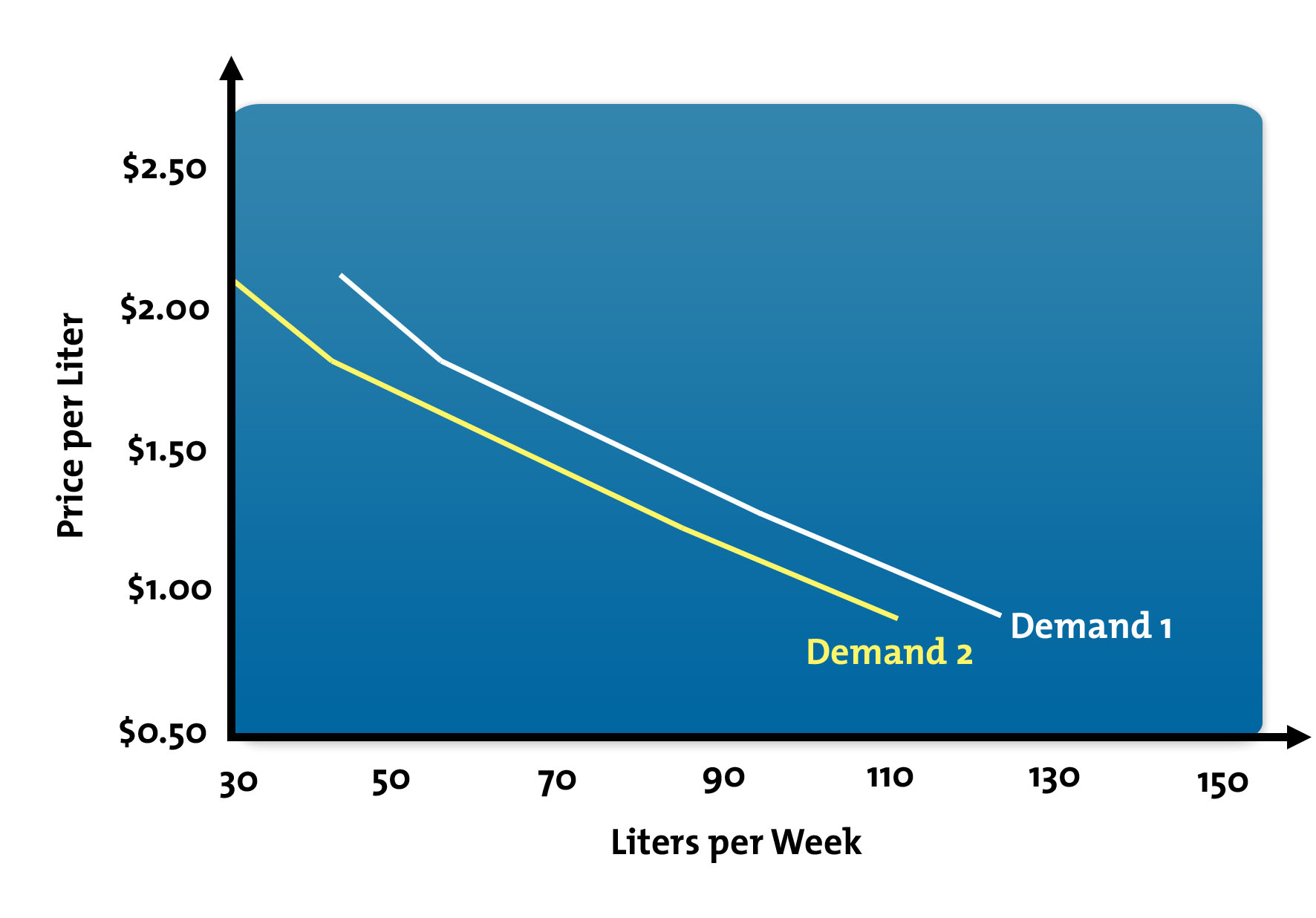
Let's render to our gas instance. If there's a long-term increment in the toll of gas, the pattern of demand changes. People may start walking or cycling to work, or buy more gas-efficient vehicles. The result is a major modify in total demand and a major shift in the demand curve. And, with a shift in demand, the equilibrium indicate also changes.
You lot tin can see this in Effigy four, where Demand Curve 2 differs from Demand Curve 1, shown in Effigy 1. At each price point, the total need is less, so the demand bend shifts to the left.
Figure four: Demand Shifts
Changes in any of the following factors can crusade need to shift:
- Consumer income.
- Consumer preference.
- Price and availability of substitute goods.
- Population.
The same type of shift tin can occur with supply. When supply decreases, the supply curve shifts to the left. When supply increases, the supply curve shifts to the right. These changes take a corresponding event on the equilibrium point.
Changes in supply tin result from events such as:
- Changes in production costs.
- Improved technology that makes production more efficient.
- Manufacture growth or shrinkage.
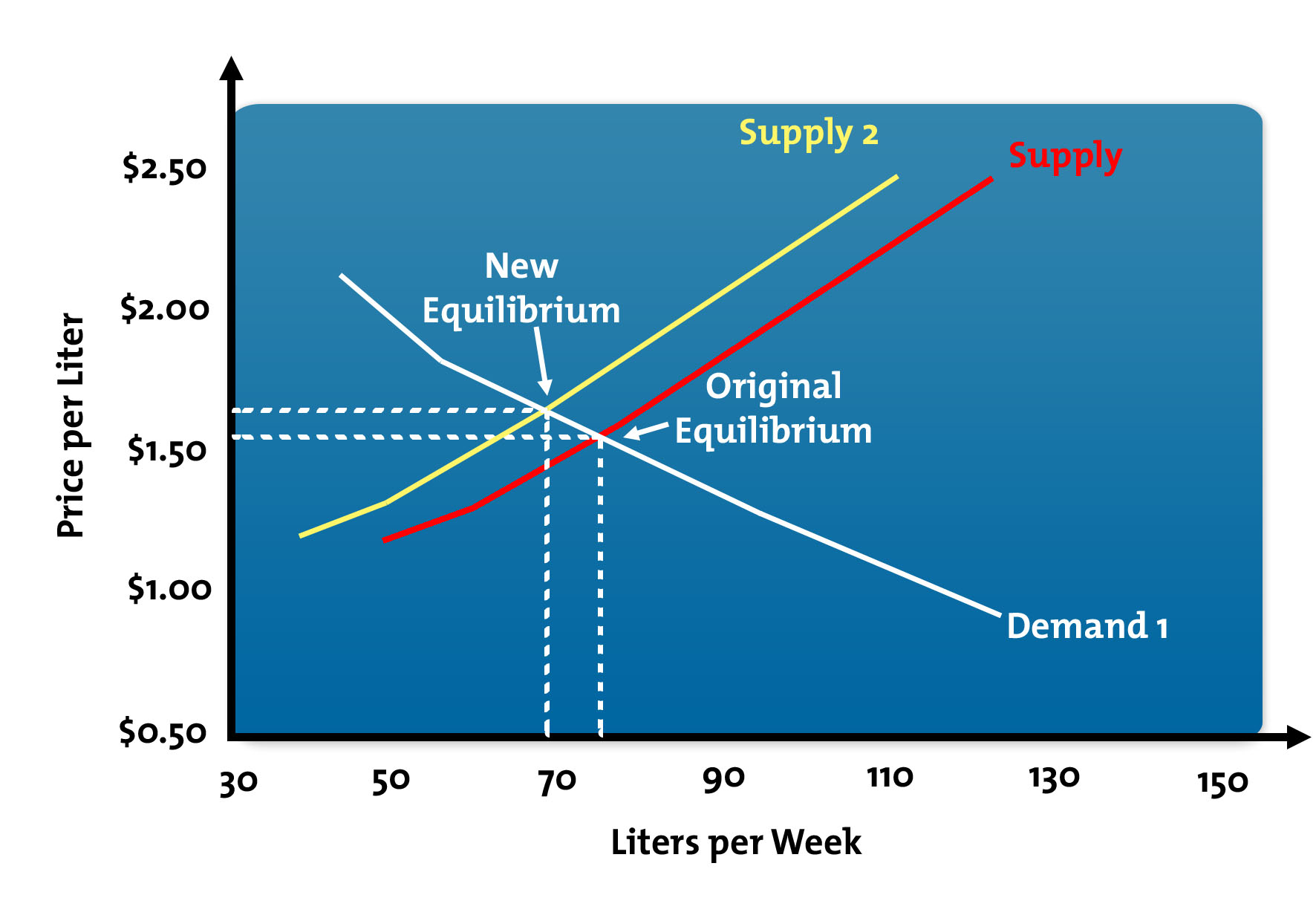
To consider our example i more than fourth dimension, permit's say that drilling costs take increased and the oil companies have reduced the supply of gas to the market (Supply two). The result is a higher equilibrium cost, equally shown in Effigy 5.
Figure 5: Change in Marketplace Equilibrium
You can use supply and demand curves similar these to assess the potential impact of changes in the price that you charge for products and services, and to consider how shifts in supply and need might impact your business.
Key Points
Although the phrase "supply and need" is commonly used, it'southward not always understood in proper economical terms.
The price and quantity of appurtenances and services in the marketplace are largely adamant by consumer need and the amount that suppliers are willing to supply.
Demand and supply can be plotted as curves. The indicate at which the two curves come across is known equally the marketplace quantity supplied. The market tends to naturally move toward this equilibrium – and when total need and total supply shift, the equilibrium moves accordingly.
Understanding this relationship is fundamental to analyzing your market, setting toll points finer, and allocating company resource in a price-effective manner.

Source: https://www.mindtools.com/pages/article/newSTR_69.htm
Posted by: hornbackfortell.blogspot.com
0 Response to "How To Draw A Supply And Demand Curve"
Post a Comment